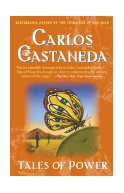
This Book @ Amazon.com (From $8.64)
This Book @ Amazon.ca (From $CAN 8.25)
This Book @ Amazon.co.uk(From £26.99)
= Amazon.com |
= Amazon.co.uk |
= Amazon.ca.
|
|
|
|
|
|
|
|
|
|
|
|
|
|
| 
One of My Favorite Two Castaneda Books, But Might Require Some Background
Review written by: L. Erickson From Los Angeles, CA
This, along with The Power of Silence: Further Lessons of don Juan, are my two favorite Carlos Castaneda books, and I think I have read them all at some point. It is exactly what the title suggests - tales, tales of power. The list of 'lessons' and exercises from books like Journey to Ixtlan: The Lessons of Don Juan are gone. Carlos' writing has also improved, and he manages to weave these stories together beautifully. Some parts are very moving, which was unthinkable in the first couple of books.
I do wonder if someone could pick up this book and just read it cold however, without having read any prior Castaneda books. I suspect not, and would recommend Journey to Ixtlan: The Lessons of Don Juan as a good starting point.
As for what's real and what's not, I don't think it's relevant. On one level this book is about the role of story in our own lives, and in all cultures and especially metaphysical traditions. These stories convey truths beyond the distinction of 'truth' and 'fiction'. So my advice is just read them, and absorb, and don't worry about the veracity. And if you like this book, try The Power of Silence: Further Lessons of don Juan afterwards.
tales of power
Review written by: Michael J. Langan From
A good shipper. Quality as stated. No problems whatsoever. I highly recommend this seller.
Pulling the pieces together
Review written by: Dragan From Australia
This is the 4th book of the series and thus far my favourite. It is my favourite because in this book Don Juan explains the `how's and why's' of all of his teachings etc as found in the first 4 books; also, the reason for the ontological foundations of Shamanism and the Ethnopharmacology of spiritual transformation.
"The average man seeks certainty in the eyes of the onlooker and calls that self-confidence. The warrior seeks impeccability in his own eyes and calls that humbleness. The average man is hooked to his fellow men, while the warrior is hooked only to himself" - pg 13
Yes interesting enough, this book takes us from the desert, to the City of Mexico, whereupon Don Juan and Don Genaro further instruct Carlos Castaneda in the ways of a sorcerer. The first chapter to page 50 deals with Carlos discovering that Don Juan and Don Genaro have doubles, that we all have doubles. This coincides with the esoteric teaching of the twin as is also found in Gnostic teachings i.e. see also the twin of Jesus.
This book goes into the teachings of the Tonal and Nagual. I recall from reading a critique of the whole Castaneda books, that according to the lineage of teachings associated with the `Tonal & Nagual', Carlos Castaneda differs. It is sprouted from the critics, that this is further proof of the fiction of Carlos's books. I'm not sure of this, but I'm not about to pass judgment on this as yet. To me, Carlos's teaching regarding this is very insightful; I for one at this time, without reading the rest of the Carlos Castaneda books and books by the critics, will continue to fence sit; more so after reading this book.
The Tonal seems to represent the Malkuth, the forging together of man via the emotions to physicality; to all that holds this, in a "bubble", together. To stop the internal chatter is to stop the tonal. The Nagual is the true self, the non-ordinary reality; the dealings between these, as revealed by Carlos Castaneda, are truly marvelous. To have stepped into the great void of the Nagual and discovered that "Something in you realized your true nature, that you are a cluster" pg 263. The tonal with its reason and the Nagual with its will, thelema. This once again coincides with esoteric teachings. Don Juan further expounds on the teachings of `not doing' he tells us that looking at the shadows, something we don't ordinarily pay attention to, is something of which, if one does, stops the tonal i.e. an act of `not doing'.
This book further brings into question the problem of fact or fiction. It pushes the esotericist towards the reality of the words of Carlos Castaneda. How is it that such wonders are revealed otherwise? Others had let the ending of this book slip; this ending posed a serious question. This question, I was happy to find, was posed by Carlos to Don Juan i.e. was it real? I'd rather not spoil the end scene of this book regarding the specific act, which one can easily find with other reviews. The answer given is here, "reason reflects and outside order", "we are a cluster of feelings", "we merely witness the effects of the tonal and the Nagual", "in both cases there is no hope, even to understand or explain what it is that we are witnessing". In a way one really has to read the book to further understand what is being said here. For me though, this deals with the matrix, plasticity, tree of the kabbalah, Maya, the tonal and the Nagual. A simple conversation I had of recent with a lady regarding what I know as corruption in the medical establishment; she had worked for an insurance company. Her world was firmly entrenched in the Malkuth, solid illusion. The Malkuth, a degree of vibration, of which at any moment can be interjected with another frequency of vibration, causing ones reality to come crashing down, enter the Nagual.
Onwards, book No 5, `The second ring of Power'.
Amazing writer and book
Review written by: Carolyn Moulton From
This is the first book I read by Carlos Castaneda and I was enthralled by the book I had it read in three days, I am not much of a reader however this book pulled me right in I couldn't put it down, the way he writes you can picture yourself right there. I recommend this book 100% with 5 stars, I believe once you read it you will be hooked to the author as well. Carlos is amazing!!
Enthralling book, but only until you realize it was all fantasy
Review written by: Michael From Hamburg, Germany
That might not come from reading this book alone, as it is the fourth most believable of the series. When I was a student, I like many others I know who will confess to having read a Castaneda book or two when pressed, went through a couple of years of Castanedism, reading the 8 classics 2 - 3 times each, and even the later four, quite different books a couple of times. Being someone who likes to give the benefit of the doubt until conclusive evidence proves otherwise, I must admit to only getting suspicious by Journey To Ixtlan, the third book. The second book, A Separate Reality, picks up on the supernormal happenings, but still these are within the realms of possibility, when one considers Spiritualist literature. By Tales of Power, when at the end Carlos throws himself off a cliff and only survives by becoming pure perception, bouncing elastically back and forth 17 times between the two inherent realms of all creation, the tonal and the nagual, the game was up. In Carlos' terms, my assemblage point had just experienced a considerable shift into the realms of disbelief. The cocoon had burst. I read the remaining books still interested, but with the growing realization that I'd been had. Bizarre ideas not found in any other spiritual traditions, such as the necessity for people on the path of knowledge to kill their children to reclaim the power they'd lost to them, plus fill in the holes in their cocoons the children had caused, made me wary. This was surely not a philosophy the whole world should turn to, or else we'd be living in a fearful, lonely world with every man for himself.
However, this would be fine if the books weren't made out to be non-fiction. While I have seen these books placed with science fiction books in many libraries, in most European bookshops they're still sold with real, non-fiction 'Mind, Body, Spirit' books. The reason I give this book such a low rating is that an intensive study of his works, the books by his various colleagues, plus Richard De Mille's intelligent criticisms, can only lead to the conclusion that Castaneda, the writer, used Don Juan and Carlos, two fantasy characters, to verbalize his own beliefs, which were culled from his own spiritual and academic experience. That there are not some useful nuggets of wisdom, or advice in these books I do not deny. That is their very attraction, plus the belief that it all really happened, and is a new spiritual revelation. But as these are mixed up with increasingly bizarre assertions and beliefs (by the Art of Dreaming it seems all pretence at non-fiction had been given up), it is doubtful whether a lifetime devoted to these practices (as opposed to say, real shamanic practices) would lead to spiritual improvement. If you must have a Castaneda book in your library, rather get The Wheel of Time, a selection of the spiritual highlights of the first eight books, but consider it rather 'The best of the personal philosophy of Carlos Castaneda' than anything to do with Don Juan or Shamanism. This understanding may not have the romantic mix of wild Mexican deserts, ancient wisdom, wise old men and naive westerners which captures the hearts of so many, but it is a lot closer to the truth.
The anonymous ghost-writer at Schuster and Schuster who corrected Peruvian immigrant Castaneda's English for at least all of his earlier works (a sample of his writing from 1969 reveals it was still far from perfect, not like what is in books), giving the books their special character, certainly deserves more credit than he or she gets. But they are not written well enough to succeed as fiction, hence their continued classification as non-fiction, besides the intense academic embarrassment it would cause copyright holders UCLA to have to admit such a dramatic change in classification, from fact to fantasy, after having previously given the author a doctorate for his work! I give this book one star on the basis that any book claiming to represent the truth which is later found to be fraudulent deserves no stars by definition, so I must give the minimum rating allowed. The day this book is reclassified as Fiction, I will up my rating to 3 stars though, as it is a quite entertaining and authentic piece of fiction-posing-as-non-fiction.